Is this a joke?+
We would never joke about something this serious. The premise is funny, sure, but the measurements are real and so is the benefit. Both can be true at once. That's the whole design.
Does it actually use my camera?+
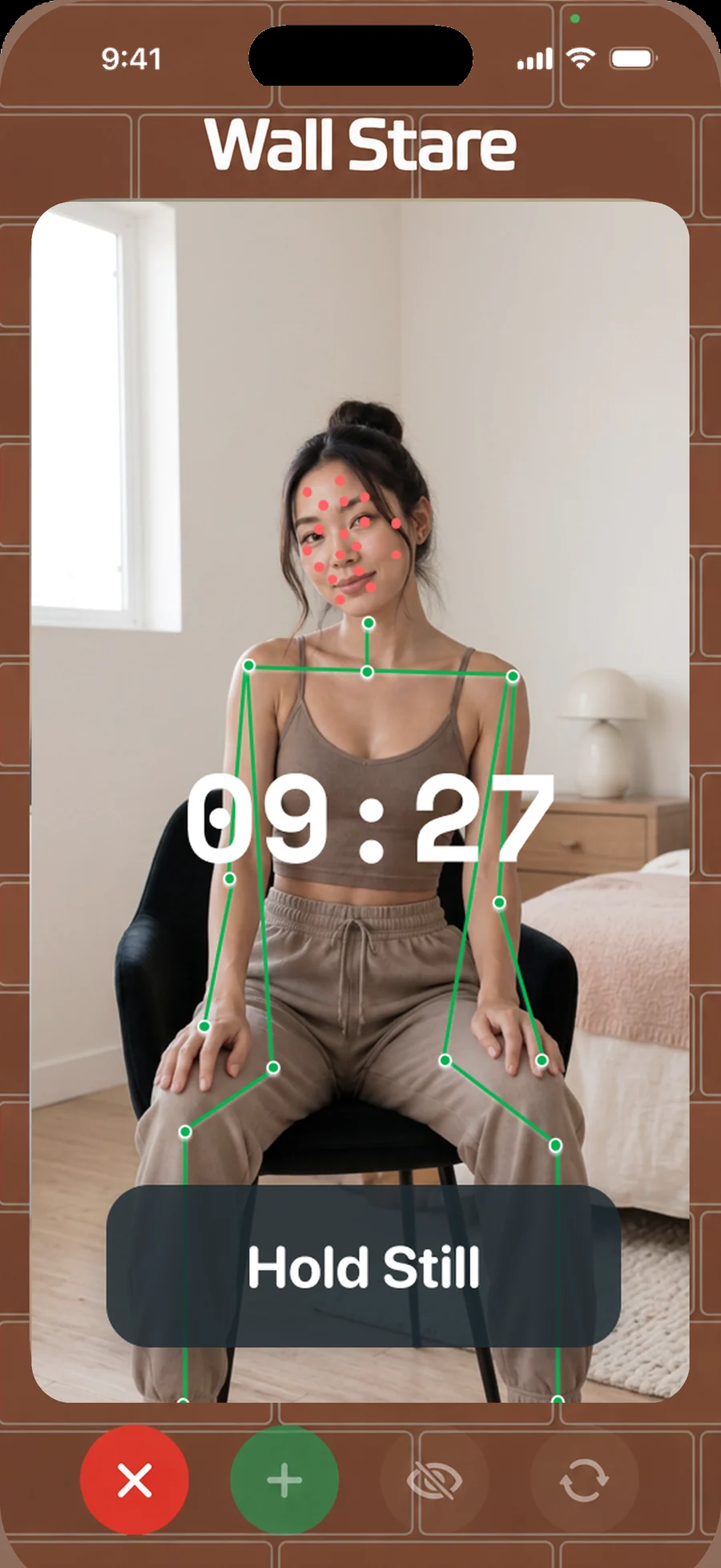
Yes, entirely on-device. The front camera reads your posture, gaze and movement to score the session in real time. No footage is recorded, saved, or uploaded. The one exception is opt-in: after a session you can choose to save a photo of your wall, and only then. What happens between you and the wall is strictly between you two.
Will this actually do anything?+
Stillness is trainable, and attention is the muscle underneath it. A few quiet minutes a day rebuilds your tolerance for doing nothing.
How long does a session take?+
As little as you like. Five minutes counts. Most people settle into ten, and the daily goal is yours to set. You can stop any time; the wall is endlessly patient.
What does a good score look like?+
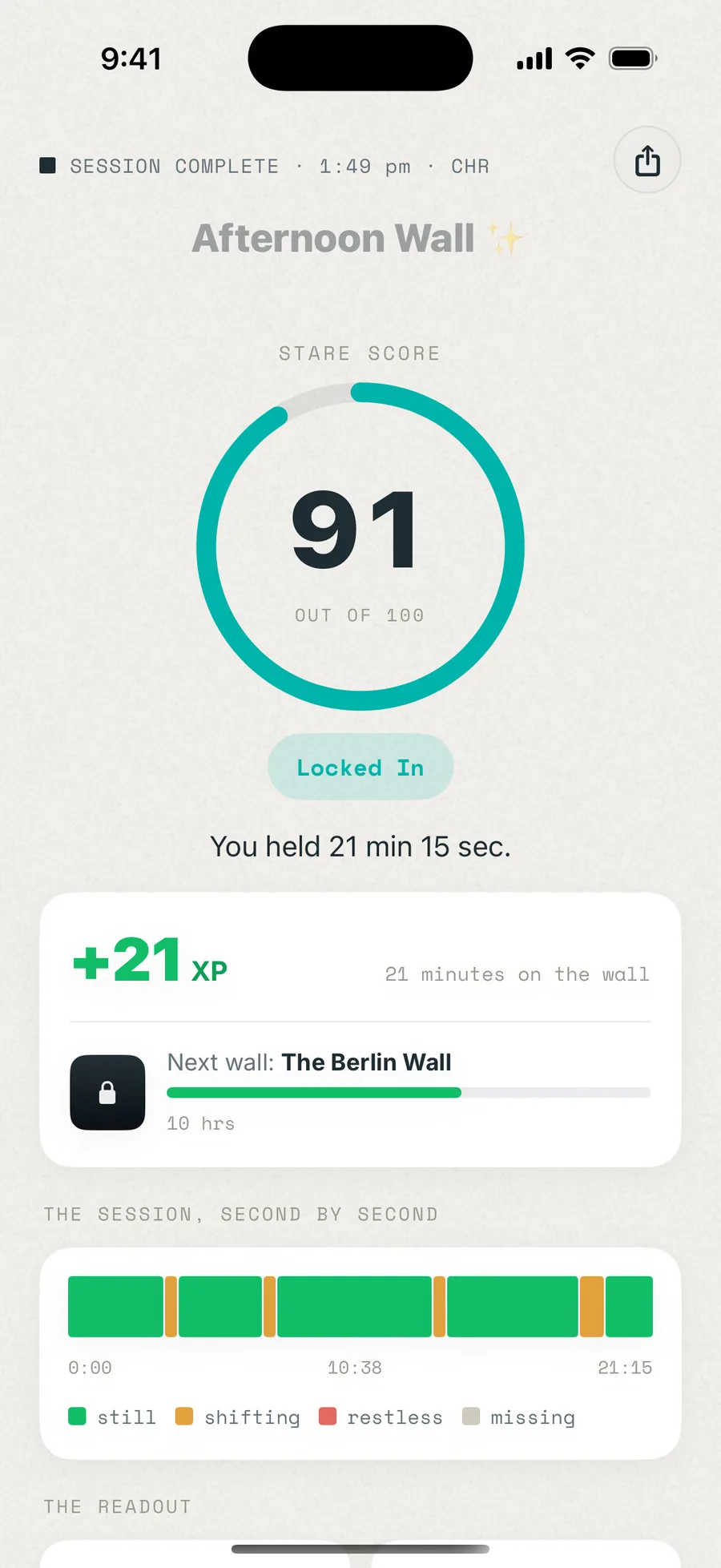
Most first-timers lose to the wall in about eight seconds. A few minutes is respectable. Eleven minutes of unbroken stillness earns the wall's respect — which it does not give easily, and never says out loud.
How does the app blocking work?+
Pick your worst apps and they stay locked until you've hit today's staring goal — then they unlock until midnight. You set the rules once; the wall enforces them daily.
Wait — I have to pay to stare at a wall?+
You're already paying — in hours, to a feed engineered to win. This is about a dollar a week to get some of that back, by rebuilding the one thing the feed quietly took. No ads, no data sold, nothing recorded: the subscription is the whole business model, which is exactly why nothing else has to be. The wall, for its part, works for free.
What happens if I cancel?+
Plans renew automatically until you cancel. Cancel, and you keep everything until the end of what you've already paid for — nothing renews after that. It's two taps in your App Store subscriptions, no phone call, no dark patterns.
Is there a free trial?+
No. At about a dollar a week a trial mostly buys people who cancel on day seven, and we would rather the first crowd through the door be people who actually meant it. If it isn't for you, cancel in two taps and keep what you paid for.
Does it work on Android?+
iPhone first. Android is staring at the wall, waiting its turn.